Doctor Reports
Turn months of tracking into a clearer conversation
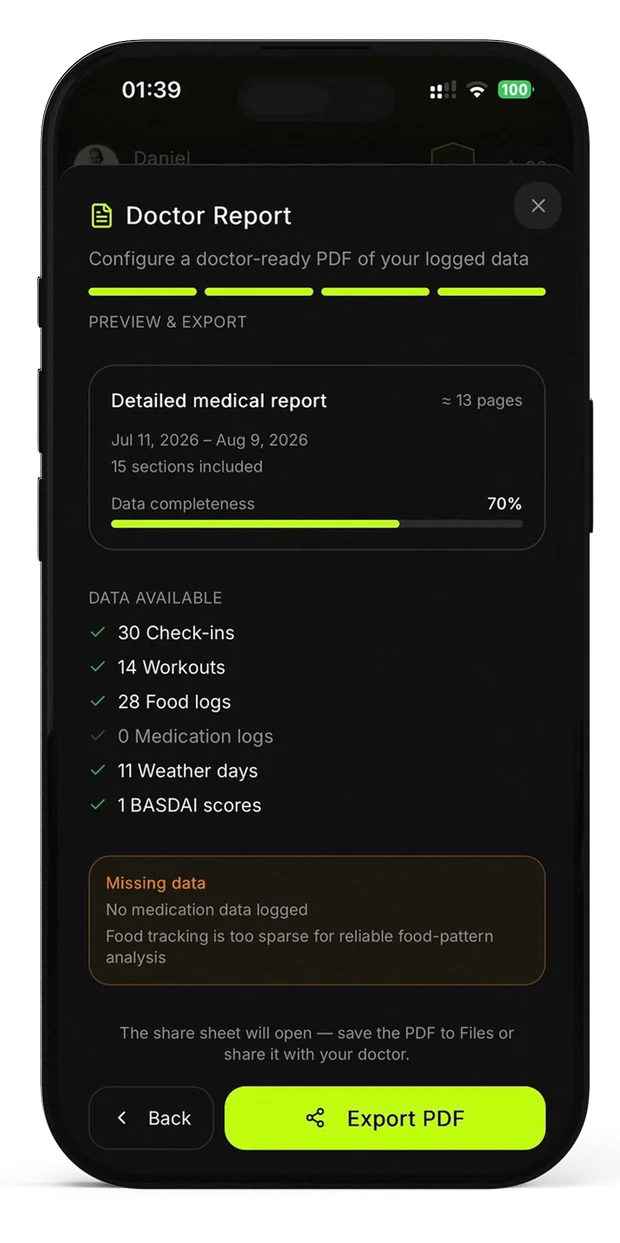
Appointments are short and memory is unreliable. HAVYT condenses what you have recorded into a structured summary you can actually work through with a clinician.

The ten-minute problem
You have been tracking for months. The appointment lasts ten minutes. Somewhere in between, "how have things been since I last saw you?" has to be answered.
Scrolling through individual entries does not work in that room, and neither does memory — recall is heavily weighted toward the last few days and the worst ones.
A summary of what actually happened is a better starting point than either.
How a report comes together
- You track normallyDaily check-ins, symptoms, training, recovery, medication — whatever you already record.
- Choose a periodSince the last appointment, or whatever window is relevant.
- HAVYT structures itTrends and recorded history are organised into sections rather than a list of raw entries.
- Review it togetherBring it to the appointment as a starting point for the conversation. The rheumatology appointment guide covers what else to bring and what to ask.
What makes a summary useful to a clinician
Direction and duration usually matter more than any single number. Whether stiffness has been building for six weeks or arrived last Tuesday changes the conversation; a score of seven on its own does not.
A report is most useful when it is honest about gaps, too. Days you did not record are days with no data, and HAVYT does not fill them in.
Who finds this most useful
Living with a chronic condition
Regular appointments where "how has it been?" is the opening question every time.
Being assessed
You are still working toward an answer and a clear record of symptoms over time genuinely helps.
Changing something
New medication, new routine, and you want a before and after that is not based on impression.
What a Doctor Report is not
It is a summary of what you recorded — self-reported information, with the limits that implies. It is not a clinical record, not a diagnostic result, and it does not replace examination, imaging or blood work.
Your clinician decides what is relevant. The report exists to make your own account easier to give, not to reach conclusions on your behalf.
HAVYT is not a medical device. It does not diagnose, treat, cure or prevent any condition, and it is not a substitute for professional medical advice.
Common questions
What information should I bring to a doctor about chronic pain?
Usually: how symptoms have changed over time rather than a single day, when they are worst, what you have tried, and anything that changed alongside them — sleep, activity, medication. A tracked history covering the period since your last appointment answers most of those more reliably than recall.
Can I export my data?
HAVYT generates a structured Doctor Report from your tracked history that you can review in an appointment.
Is a Doctor Report a medical record?
No. It is a summary of self-reported tracking. It sits alongside your clinical records; it does not replace them.
Does it include everything I have tracked?
It focuses on trends and recorded history over the period you choose, structured for review rather than reproducing every individual entry.
Will my doctor accept it?
That is up to them. Most clinicians work with whatever a patient brings; the report is designed to make your own account clearer and quicker to give, which is generally welcome in a short appointment.
Walk in with something to show
The report is only as good as the history behind it. Start tracking before the next appointment, not after.