Pain diary · Symptom tracking
Track chronic pain in context
A pain score on its own rarely explains anything. HAVYT records pain next to sleep, stiffness, energy, mood, medication and what you actually did, so a difficult week has something around it — and months of entries become a report you can bring to an appointment.
Updated

Why a pain diary often stops being useful
Most pain diaries ask one question: how bad was it today, from one to ten. That is easy to answer and hard to use. A row of numbers tells you that some days were worse without telling you what else was true about them. Chronic pain — pain lasting more than three months — affects roughly three to five in every ten people (NICE NG193), and most of them have been told to keep a diary at some point.
The information that would make those numbers meaningful is usually scattered — sleep in one app, workouts in another, medication in your head, and mood nowhere at all.
HAVYT keeps them in the same place, which is the only way a possible pattern can become visible. The pain diary guide covers the structure whether or not you use an app.
What HAVYT records
Pain by location, and stiffness
Pain is tagged to a body region rather than described in words, and stiffness is tracked separately, because they often behave differently. See pain tracking for AS for why the split matters in inflammatory conditions.
Sleep, energy and mood
Part of the same daily check-in, so they are never missing when you look back. Sleep and chronic pain covers why sleep earns its own line.
Activity and training
Workouts, mobility sessions and GPS activities, with sets, reps, weight and rest where relevant — and whether you scaled a session down. See exercise and chronic pain.
Medication
Recorded alongside everything else rather than in a separate list, so a missed dose sits next to the day it might explain. See medication tracking.
Connected health data
Apple Health can contribute sleep, resting heart rate, HRV, steps and more when you allow it.
Questions worth asking your own history
These are framed as questions on purpose. HAVYT surfaces possible relationships; it does not assert causes.
- Do difficult mornings tend to follow shorter or more disturbed sleep?
- After a heavier training week, what did the following few days look like?
- Are there habits that seem to coincide with better stretches?
- Has anything actually changed over the last two months, or does it only feel that way?
How it works
- Check in dailyUnder a minute. Consistency matters more than detail.
- Let it accumulateA single day says little. A few weeks starts to have shape.
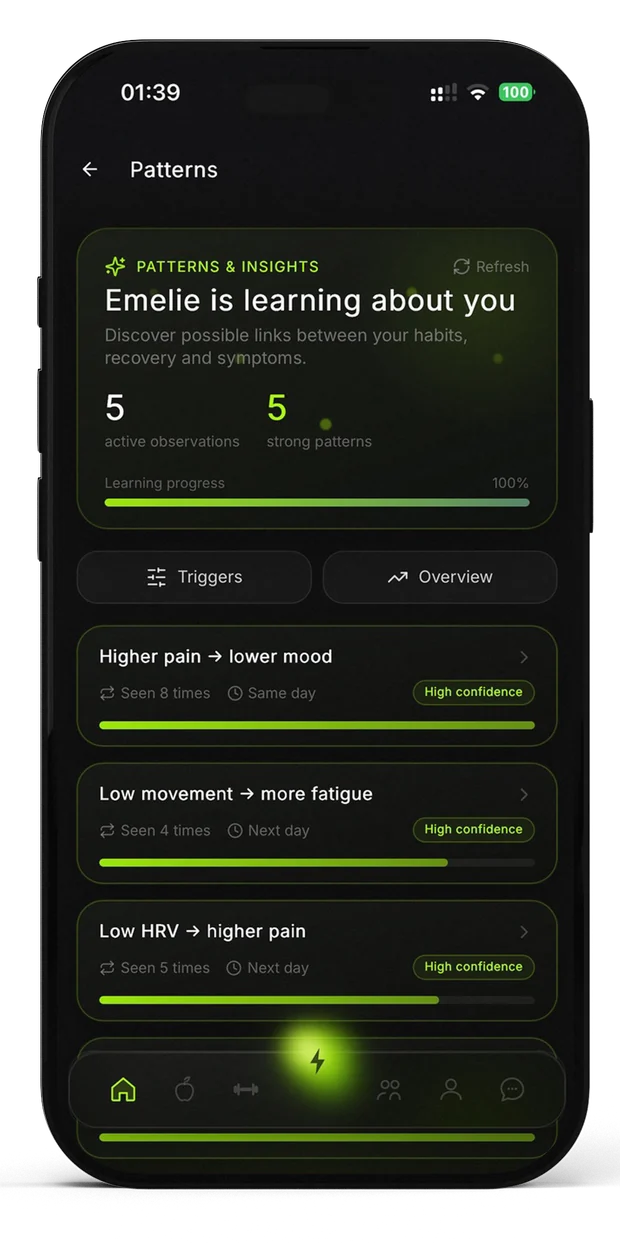
- Look for possible patternsHAVYT compares what you have recorded and surfaces relationships worth examining, labelled by how often they were seen. How to track pain patterns explains what a pattern can and cannot tell you.
- Take it to an appointmentDoctor Reports turn months of entries into something reviewable in ten minutes.
Guides for keeping a pain record
Written for anyone living with chronic pain, whatever they use to record it.
- How to keep a pain diaryThe minimum daily entry, scoring pain consistently, using a body map, and reading a month back.
- How to track pain patternsWhat to compare, how many weeks you need, and the difference between an association and a cause.
- Sleep and chronic painThe evidence that sleep and pain run in both directions, and the sleep fields worth recording.
- Medication trackingWhy timing and missed doses matter, and what to bring to a prescriber without self-adjusting.
- Flare trackingRecording flares as they happen so a year of them can be counted and described.
- Printable pain diary templateOne week per page, free, no sign-up.
Being clear about what this is
A pattern in your data is a correlation, not a cause. Bodies are complicated, and the thing that changed may not be the thing you recorded. Bring an association to a clinician as an observation; do not change medication or make large changes on the strength of a diary alone.
HAVYT will not tell you why you are in pain, and it cannot identify an underlying condition.
HAVYT is not a medical device. It does not diagnose, treat, cure or prevent any condition, and it is not a substitute for professional medical advice.
Common questions
How is this different from a pain diary app?
A pain diary usually records pain alone. HAVYT records pain alongside sleep, stiffness, energy, mood, activity and training, and then compares them across your own history, which is where possible patterns become visible.
Do I have to log every day for it to work?
No, but consistency helps. The value comes from having enough history to compare, so a short daily check-in is more useful than an occasional detailed one.
Can I use HAVYT without an Apple Watch?
Yes. Everything can be entered manually. Apple Health adds context if you have a device writing to it, but nothing in HAVYT requires one.
Can HAVYT tell me what causes my pain?
No. It can show that two things tended to occur together in your recorded history. That is a starting point for a conversation with a clinician, not an explanation.
Is my health data private?
Your tracked health data stays in your HAVYT account. It is not shared with advertising or analytics providers — see the Privacy Policy for how data is handled.
Give the numbers something to sit next to
Start with a daily check-in and let a few weeks accumulate. That is when it starts to be worth reading.