Emelie
An AI coach that already knows your context
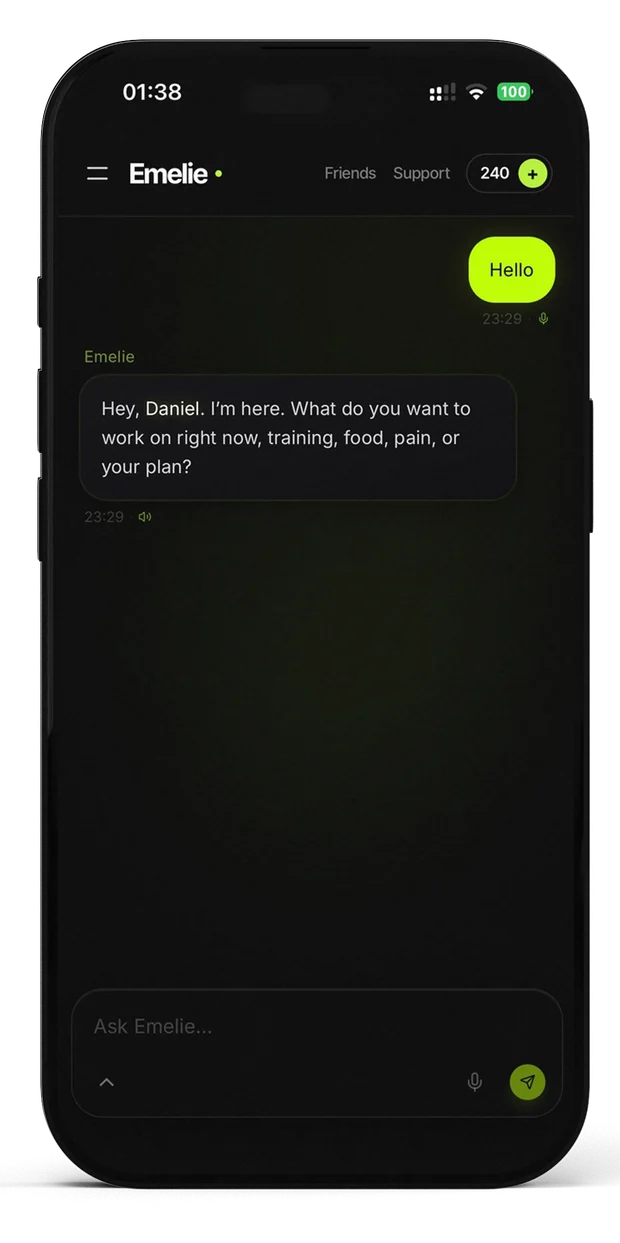
Most AI assistants start every conversation from nothing. Emelie starts from what you have recorded in HAVYT — your check-ins, your training, your recovery.

The problem with asking a general chatbot
You can ask any AI assistant whether to train today. It will give you a reasonable, generic answer, because it has no idea how you slept, what your stiffness has been doing, or that you trained heavy on Tuesday.
To get a useful answer you have to describe all of that first — every time. Most people stop bothering after the second attempt.
Emelie already has it, because it is the same app you recorded it in.
What that changes
Chat
Ask about a session, a stretch of difficult days, or what your recent check-ins have looked like, without re-explaining your history.
Voice
Talk to Emelie instead of typing — useful mid-session, or on a morning when typing is the last thing you want to do.
Your own data
Answers are grounded in what you have logged: training, recovery, symptoms, check-ins. Not a general guess about people in your situation.
Inside the app
No copying data between tools. The context and the conversation live in the same place.
The kind of thing people actually ask
- What did my last four weeks of training look like?
- My stiffness has been up — what else changed around the same time?
- Should today be a lighter session, given how I checked in?
- Summarise how I have been since the start of the month.
How it is paid for
Emelie runs on AI credits. HAVYT is upfront about this rather than metering silently in the background — you can see what you have and what a conversation costs.
The core tracking in HAVYT does not depend on it. Check-ins, training, symptoms and analytics work whether or not you ever open a conversation.
What Emelie is not
Emelie is not a doctor. She does not diagnose conditions, interpret test results, or tell you whether a symptom is serious — and she should not be used to decide anything about medication or treatment.
She is a language model working from what you recorded. That means she can be wrong, and she can be confidently wrong. Treat her as a faster way to read your own history, not as an authority on it.
HAVYT is not a medical device. It does not diagnose, treat, cure or prevent any condition, and it is not a substitute for professional medical advice.
Common questions
What is Emelie?
Emelie is the AI coach built into HAVYT. She can use the training, recovery, symptom and check-in data you have recorded in the app as context, so you can ask questions about your own history by chat or by voice.
How is Emelie different from ChatGPT?
Context. A general assistant knows nothing about your sleep, training load or symptoms unless you describe them every time. Emelie is inside the app where that history already lives.
Can Emelie diagnose a medical condition?
No. Emelie does not diagnose, does not interpret medical tests, and does not replace professional medical advice. She works from self-reported tracking data.
Can I talk to Emelie instead of typing?
Yes. Emelie supports voice as well as chat.
Does Emelie cost extra?
Emelie uses AI credits. The rest of HAVYT — check-ins, training, symptom tracking and analytics — does not depend on them.
Can Emelie be wrong?
Yes. She is a language model, and she can be confidently wrong. She is best used to navigate and summarise your own recorded history, with anything clinical taken to a professional.
Ask something only your own data could answer
Emelie gets more useful the more history there is behind her.