AS Mode · Ankylosing spondylitis & axSpA
An ankylosing spondylitis tracker built around real days
Morning stiffness, fluctuating pain and unpredictable energy do not fit a fixed plan. HAVYT tracks how ankylosing spondylitis actually shows up day to day — stiffness, pain, fatigue, flares and BASDAI, next to sleep, training and recovery — and adjusts around it. Built by someone living with AS.
Updated

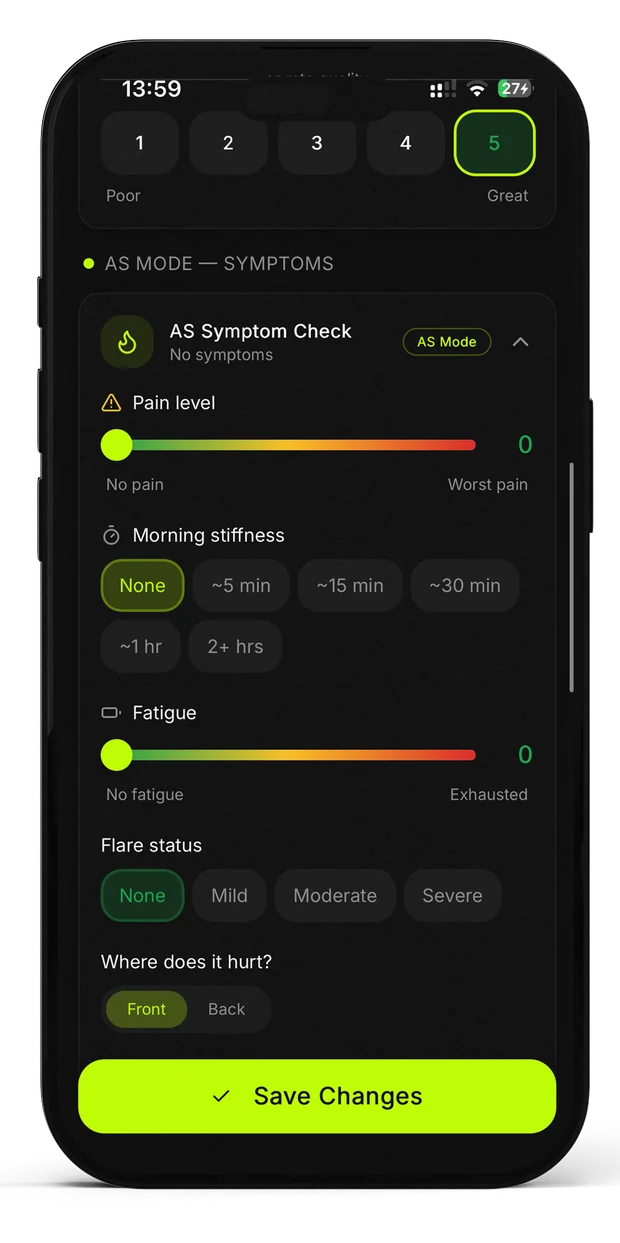
Ankylosing spondylitis, axial spondyloarthritis and axSpA
Ankylosing spondylitis (AS) is a long-term inflammatory condition that mainly affects the spine and the sacroiliac joints, with back pain and stiffness that are typically worse in the morning and at night and ease with movement. Symptoms tend to develop gradually over months or years and come and go, and AS tends to first develop in teenagers and young adults (NHS).
Ankylosing spondylitis, also known as radiographic axial spondyloarthritis, is part of the axial spondyloarthritis (axSpA) spectrum. When the same picture is present without definite X-ray changes, the term is non-radiographic axSpA. The symptoms, the value of exercise and the tracking are the same across the spectrum; the terminology guide explains the names. Everything on this page applies to AS and to axSpA alike.
Why a general fitness app struggles with AS
Most training apps assume the same person wakes up every morning. They record what you did, congratulate you when you are consistent, and mark the day missed when you are not.
Ankylosing spondylitis does not work that way. Stiffness that takes an hour to loosen, a flare that arrives without a clear trigger, fatigue that has nothing to do with yesterday’s session — these are the parts that shape whether training happens at all, and they are exactly the parts a workout log never asks about.
HAVYT was built by someone living with AS, which is why the tracking starts with how the day actually feels rather than what was lifted.
What AS Mode adds
AS Mode is not a toggle that renames a few screens. It changes what HAVYT asks you and what it puts side by side.
Stiffness and pain, separately
Recorded as distinct signals rather than one pain score — morning stiffness by duration and severity, spinal pain and other joint pain by region — because they behave differently and often move independently. See the morning stiffness tracker guide.
BASDAI tracking
The Bath Ankylosing Spondylitis Disease Activity Index is a recognised six-question self-report measure. HAVYT lets you complete it and see the score charted over time, next to the daily signals it is made of, so a rheumatology appointment starts from a trend rather than a memory. Read understanding BASDAI or try the free BASDAI calculator.
Flare context
Record when a flare starts and when it settles, and see what your own history looked like in the days before it — sleep, load, medication timing — as an association to raise with your team, never as a cause. See the flare tracker guide.
Mobility as a real option
A gentler mobility session counts as showing up. HAVYT is built so a lighter day continues your streak instead of ending it — the idea behind adaptive training, and the practical answer to exercise during a flare.
What to track with AS, and how
The guides below are written for a person keeping their own record between rheumatology reviews. None requires HAVYT.
- What to track with ankylosing spondylitisThe five signals that make an AS record useful, the context layer, and what you can safely leave out.
- Keeping an AS symptom diaryA structure that stays quick to fill in and readable months later, with a printable template.
- Tracking between appointmentsA routine for the months between reviews, and how to condense them into one page.
- Understanding BASDAIThe six questions, the arithmetic, the threshold of 4 in UK guidance, and what the score does not tell you.
- Preparing for a rheumatology appointmentWhat to bring, what to ask, and how to fit months of history into a ten-minute slot.
- Sleep and ankylosing spondylitisDisturbed sleep is reported by 35–90% of people with axSpA. What the research shows and what to record.
How HAVYT fits around AS
Four steps, in the order they actually happen.
- TrackA daily check-in covering pain, stiffness, energy, sleep and mood. Under a minute, most mornings.
- ContextTraining, recovery, medication and any Apple Health data you connect sit alongside those check-ins rather than in a separate app.
- PatternsOver weeks, HAVYT surfaces possible relationships in your own recorded history — always as something worth paying attention to, never as a cause.
- ConversationDoctor Reports condense that history into something you can actually review inside a short appointment.
The kind of question this makes answerable
HAVYT does not tell you why a flare happened. It makes your own history legible enough that you can look.
- Several high-stiffness mornings in a row — what did sleep and activity look like in the days before them?
- Has my BASDAI trended differently since I changed how often I train?
- Do the weeks where I keep mobility going look different from the weeks where I stop entirely?
- When I tell a rheumatologist "it has been worse lately", what does "lately" actually look like?
Who this is for
Recently diagnosed
You are learning what your own pattern looks like and want a record that is more reliable than recall.
Living with it for years
You already know your body. You want the tracking to keep up without becoming a second job.
Training anyway
You want to stay active without a plan that treats every day as identical. See training with ankylosing spondylitis.
What HAVYT does not do
HAVYT cannot diagnose ankylosing spondylitis or axial spondyloarthritis, and it cannot tell you whether a symptom is related to AS or to something else. Diagnosis is a clinical process involving examination, blood tests and imaging (NHS).
It does not predict flares, and it does not prevent them. Where it surfaces a possible relationship in your data, that is a prompt to look more closely and to talk to your team, not a finding.
Nothing in HAVYT should change your medication or treatment. Those decisions belong with you and your rheumatology team.
HAVYT is not a medical device. It does not diagnose, treat, cure or prevent any condition, and it is not a substitute for professional medical advice.
Common questions
Can HAVYT diagnose ankylosing spondylitis?
No. HAVYT is a tracking app, not a diagnostic tool. Diagnosis requires a clinician, and usually imaging and blood tests. HAVYT helps you keep a clearer record of symptoms once you are living with a diagnosis, or while you are being assessed.
Is HAVYT for axial spondyloarthritis as well as AS?
Yes. Ankylosing spondylitis is the radiographic form of axial spondyloarthritis; the symptoms tracked here — stiffness, pain, fatigue, flares — and the BASDAI are used across the axSpA spectrum, including non-radiographic axSpA.
Can I track pain and stiffness separately?
Yes. AS Mode records pain and stiffness as separate signals, alongside energy, sleep and mood in the daily check-in, because they often move independently.
Does HAVYT support BASDAI?
Yes. You can complete the BASDAI questionnaire in HAVYT and see the score charted over time. It is a self-report measure, not a clinical assessment on its own. There is also a free BASDAI calculator on this site that needs no account.
Do I need a wearable?
No. Every core signal in HAVYT can be entered by hand. Connecting Apple Health adds context if you have it, but nothing depends on owning a watch.
Can I bring my HAVYT data to a rheumatologist?
Yes. Doctor Reports condense your tracked history into a structured summary you can review in an appointment. It supplements your own account of how things have been; it is not a clinical record.
Does HAVYT replace my treatment?
No. HAVYT sits alongside medical care. It does not diagnose, treat or prevent ankylosing spondylitis, and nothing in the app should change your medication or treatment without talking to your clinician.
Start with one check-in
The record only becomes useful once it has some history in it. The first check-in takes under a minute.