HAVYT 1.1 is available now. It is the first big update since launch, and almost everything in it comes from the same question: how do we make HAVYT more useful on an ordinary day, not just on the day you set it up?
The short version: the Daily Check-in has been rebuilt to be faster and calmer, Emelie understands far more of what is actually inside your HAVYT, conversations on a bad day are more useful, tracking small things takes less effort, the app feels quicker, and you can now vote on what we build next. The video above walks through it in two minutes. The rest of this post goes into the why.
A Daily Check-in you'll actually want to use
The Daily Check-in is the heart of HAVYT. It is where the context comes from: how you slept, how much energy you have, how stressed you are, how sore you feel, and, if you live with pain or a condition like ankylosing spondylitis, where it hurts and how stiff you were this morning. Everything HAVYT can show you later depends on those sixty seconds.
So it had to be easy. In 1.1 the check-in is a short guided flow: one question per screen, a big dial you can move with your thumb, and nothing to scroll past. Anything HAVYT already knows from Apple Health, such as last night’s sleep, is shown rather than asked again. When you are done, you see everything on one review screen and save it together.
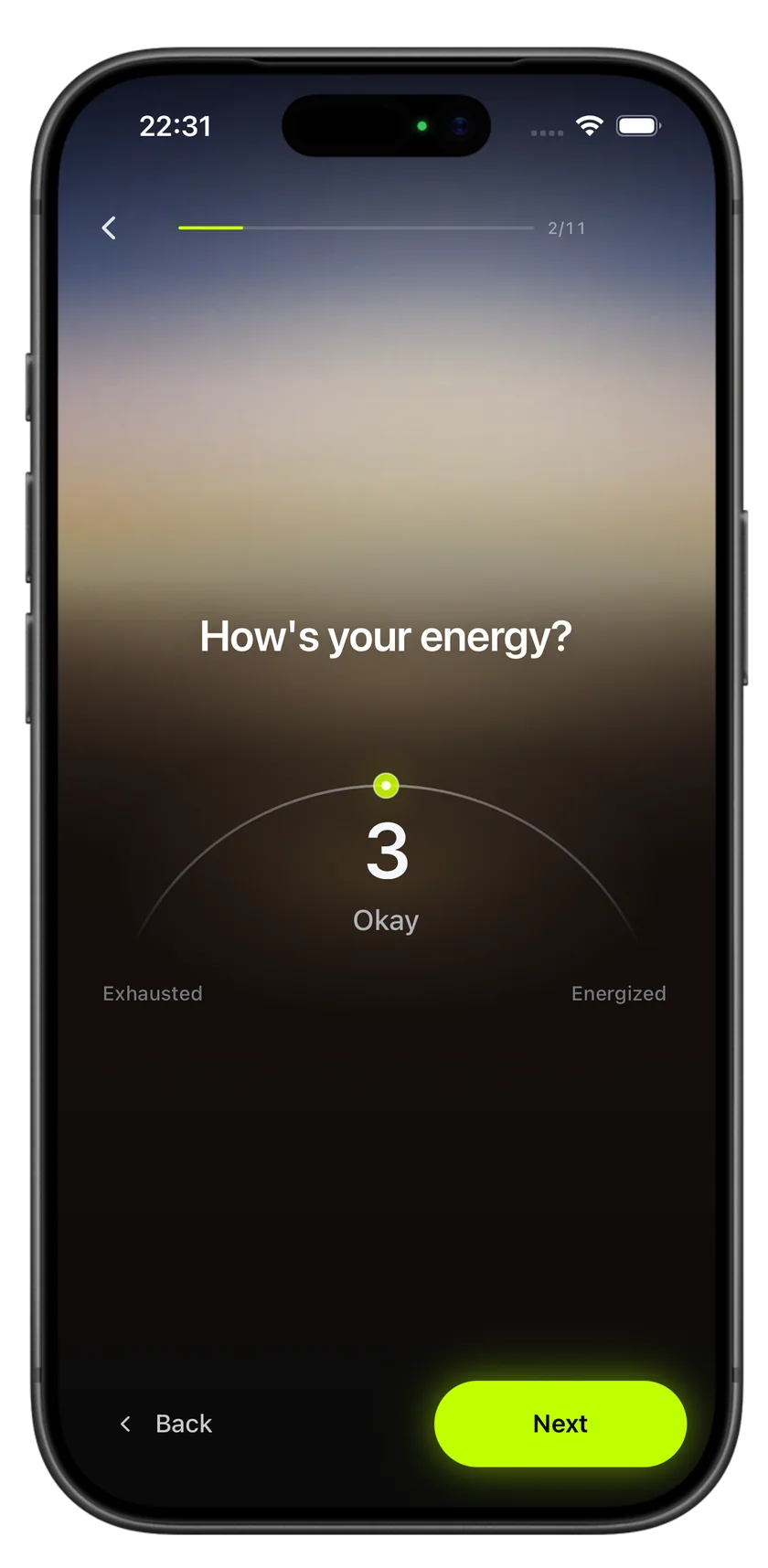
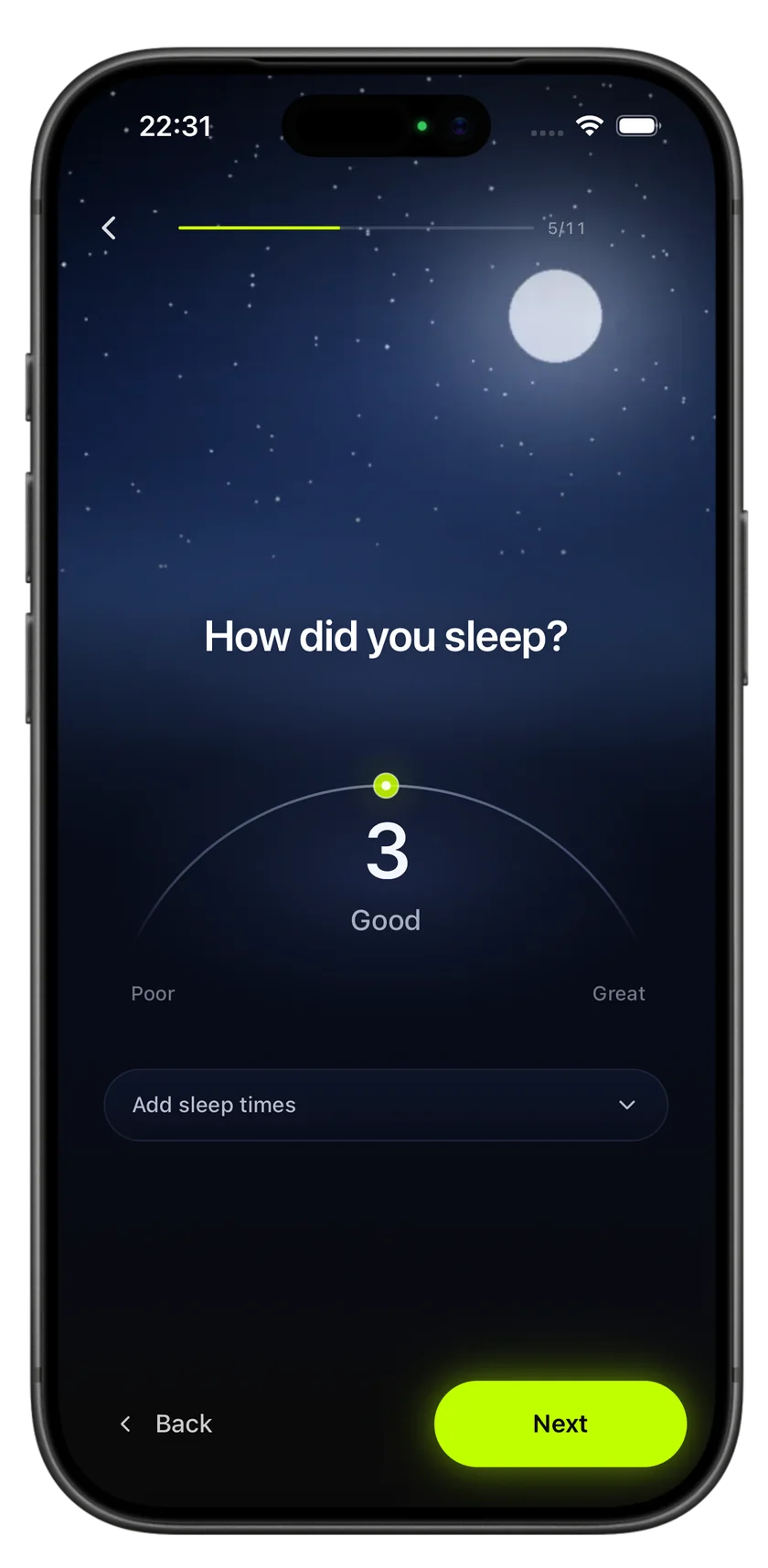
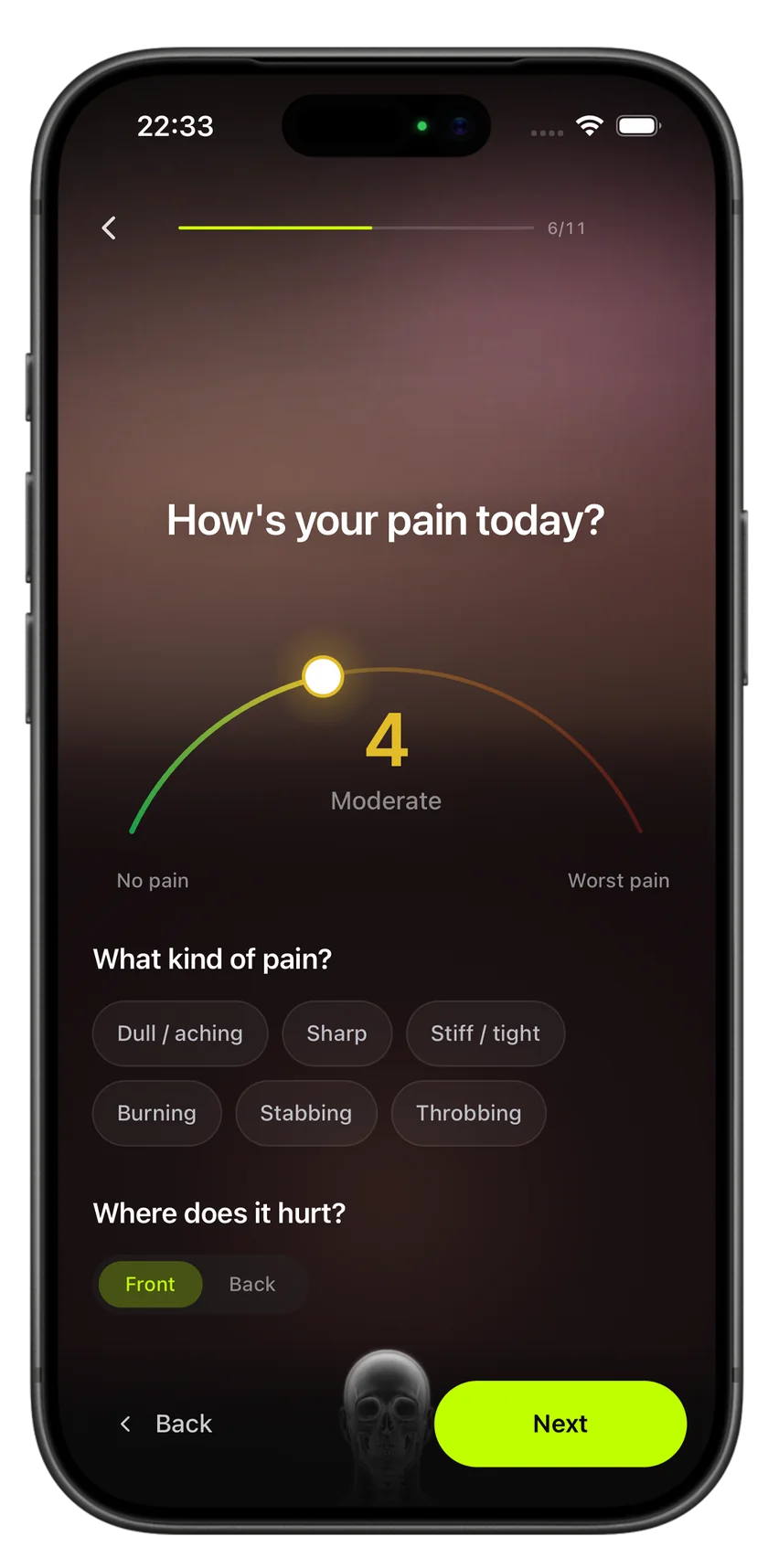
You still track the things that matter: pain, stiffness, sleep, energy, stress, soreness, mood and how you feel overall. The AS symptom questions are still there for people who need them, and they are still optional. What changed is the effort. The whole thing now takes about a minute, and it feels less like a form and more like a quick word with yourself before the day starts.
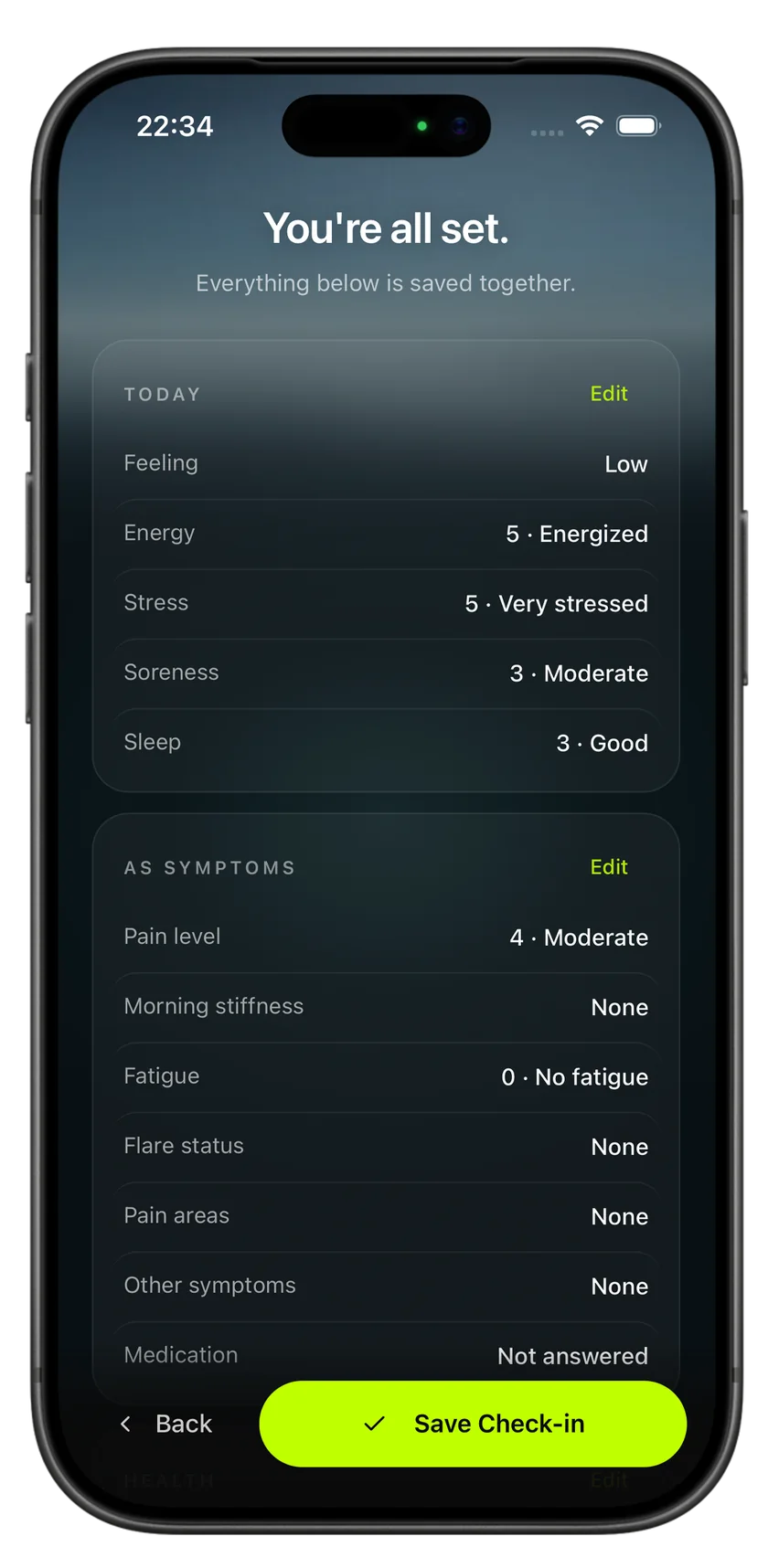
This matters more than it might look. The better the daily context, the more useful HAVYT becomes over time: your daily score compares today with your own history rather than a generic scale, pattern detection has something real to work with, and Emelie has something real to talk about. A check-in you skip because it is tedious gives you none of that.
Emelie understands much more of your HAVYT
When we launched, Emelie could answer questions about your data, but she often answered like a general assistant that happened to have a few of your numbers. In 1.1 she works much more deeply with the information inside HAVYT. Ask about today, this week, your last workout, your sleep or your last check-in, and the answer comes from your own logs, not from a web search or a guess.
- Today. “How am I doing today?” reads your check-in, your score, your plan and what you have logged so far.
- The week. “How was my week?” looks across your check-ins, sleep, training and habits over the last seven days.
- Recent workouts. “What was my last workout?” answers with the session you actually did, not a template.
- Your profile. “What do you know about me?” summarises what HAVYT holds: your goal, training days, AS Mode, latest check-in, recent sleep and training.
- Your memories. Separately, the things you explicitly asked Emelie to remember, so you can see them and check them.
That last distinction is one we spent a lot of time on. There is a difference between what HAVYT knows because you tracked it and what Emelie remembers because you told her to. In 1.1 those are kept apart and shown apart. Asking Emelie to remember something saves it to Coach Notes, and she only says it is saved once it is. Mentioning that you remember something no longer creates a note by accident.
Context now also carries across a conversation. If Emelie lists three ideas and you pick the second, she means the second one she listed. If you ask her how she would improve your plan, she reads the plan you already have and tells you what she would change, and leaves it alone until you say go. If you write to her in German, Polish or Spanish, she answers in that language and switches with you.
She is also more honest about her limits. When your logs do not explain how you feel, she says so instead of offering a plausible-sounding reason. Emelie is not a doctor and HAVYT does not diagnose anything. What she can do is put the information you have collected in front of you, in context, when you ask for it.
Better support on difficult days
A lot of people open Emelie on a bad day. Their back hurts, their hip is stiff, they slept badly and they are not sure whether to train. Before 1.1, a message like “my back hurts” too often got a short, generic answer that ended with “see a doctor”. Technically safe, practically useless.
Now those conversations start by listening. Emelie acknowledges what you said, asks one to three relevant questions (when did it start, is it different from your usual, did anything change in training), and looks at your recent check-ins and sessions for context. Then she offers conservative, practical suggestions where they fit: a lighter day, a rest, a change to today’s session, or a short mobility session built for how you feel, which she only creates if you say yes.
The careful part is deliberate. Emelie does not tell you what is causing a symptom, and she does not offer treatment. Real warning signs still get a calm, clear suggestion to seek medical help. For everything else, the goal is a more useful conversation than the one you would have with a search engine, grounded in what your own HAVYT already knows about you. If you live with chronic pain or AS, this is the part of 1.1 we most hope you notice.
Your week, today and training, easier to understand
Some questions deserve more than a paragraph. In 1.1, Emelie answers the big ones with a short sentence and a clear card you can read at a glance.
- Personal Snapshot. Your goal, training frequency, AS Mode, latest check-in, seven days of sleep and fourteen days of workouts in one view, with a Show more for the rest.
- Today Overview. Where today stands: your score, your check-in, what is planned and what you have logged.
- Weekly Summary. The last seven days across check-ins, sleep, training and habits.
- Workout Summary. The session you did, what it contained and how it went.
- Memory Summary. The things you asked Emelie to remember, listed plainly.
The cards are built from the same data as the text answer, so they never say something different from what Emelie wrote. They also respect Reduce Motion and larger text sizes, and read correctly with VoiceOver. If you are on an older version of HAVYT, you still get the full written answer.
Track more without tracking feeling like work
HAVYT has always been about minimal input and high insight. 1.1 pushes further on the input side. Water, supplements, alcohol and food can all be logged by telling Emelie in one line, and every log comes back with a confirmation card so you can see exactly what was recorded.
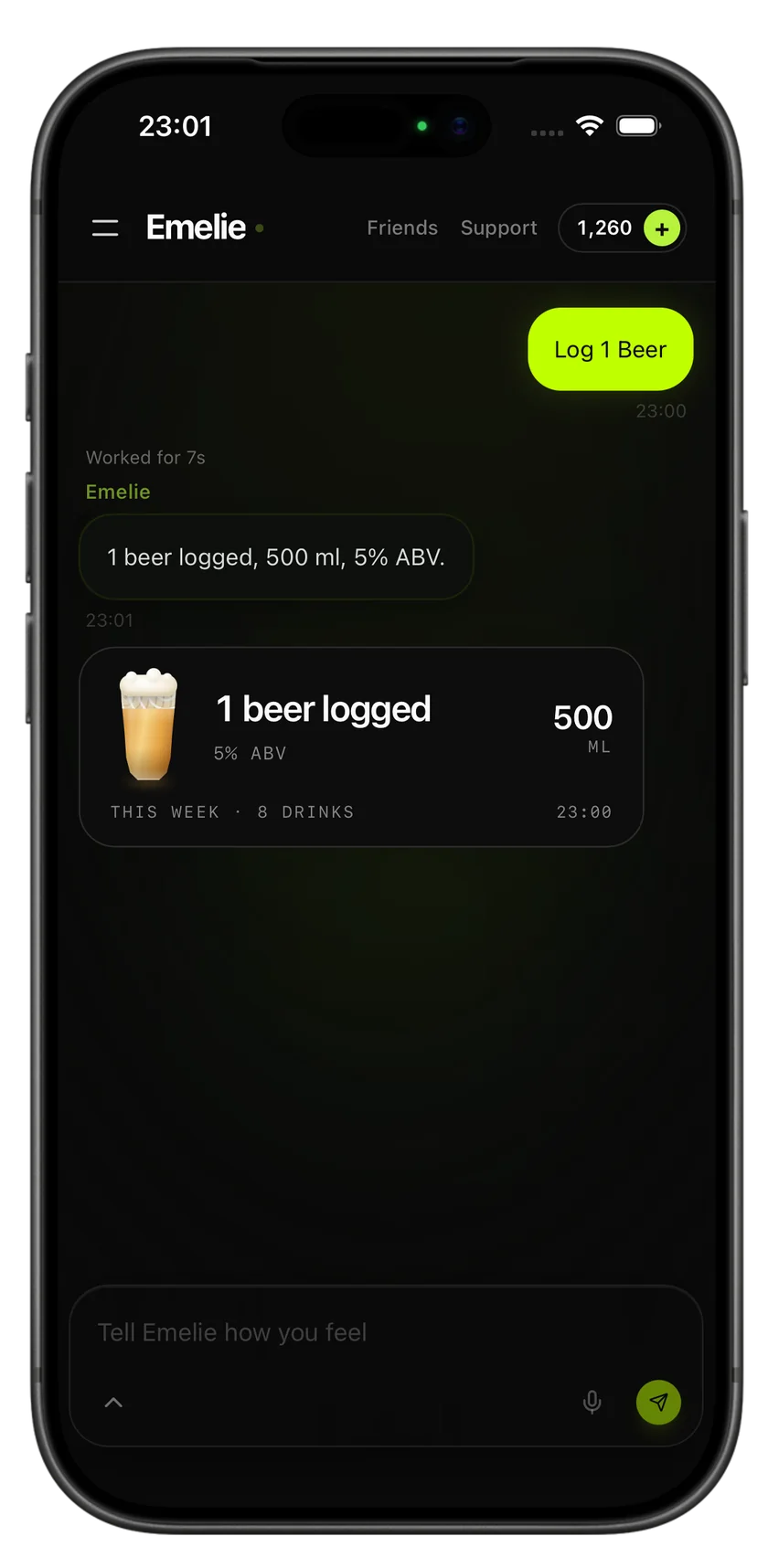
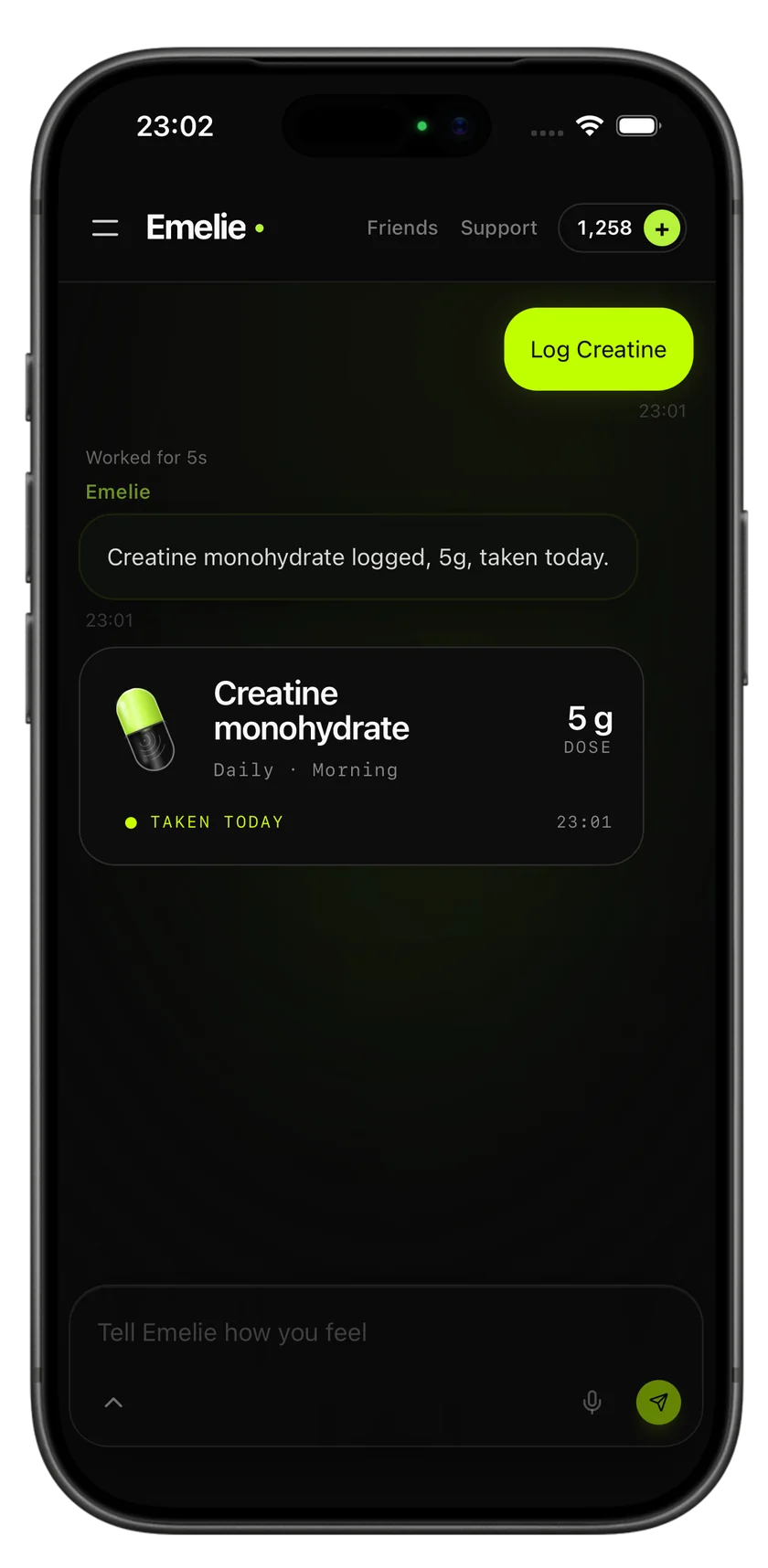
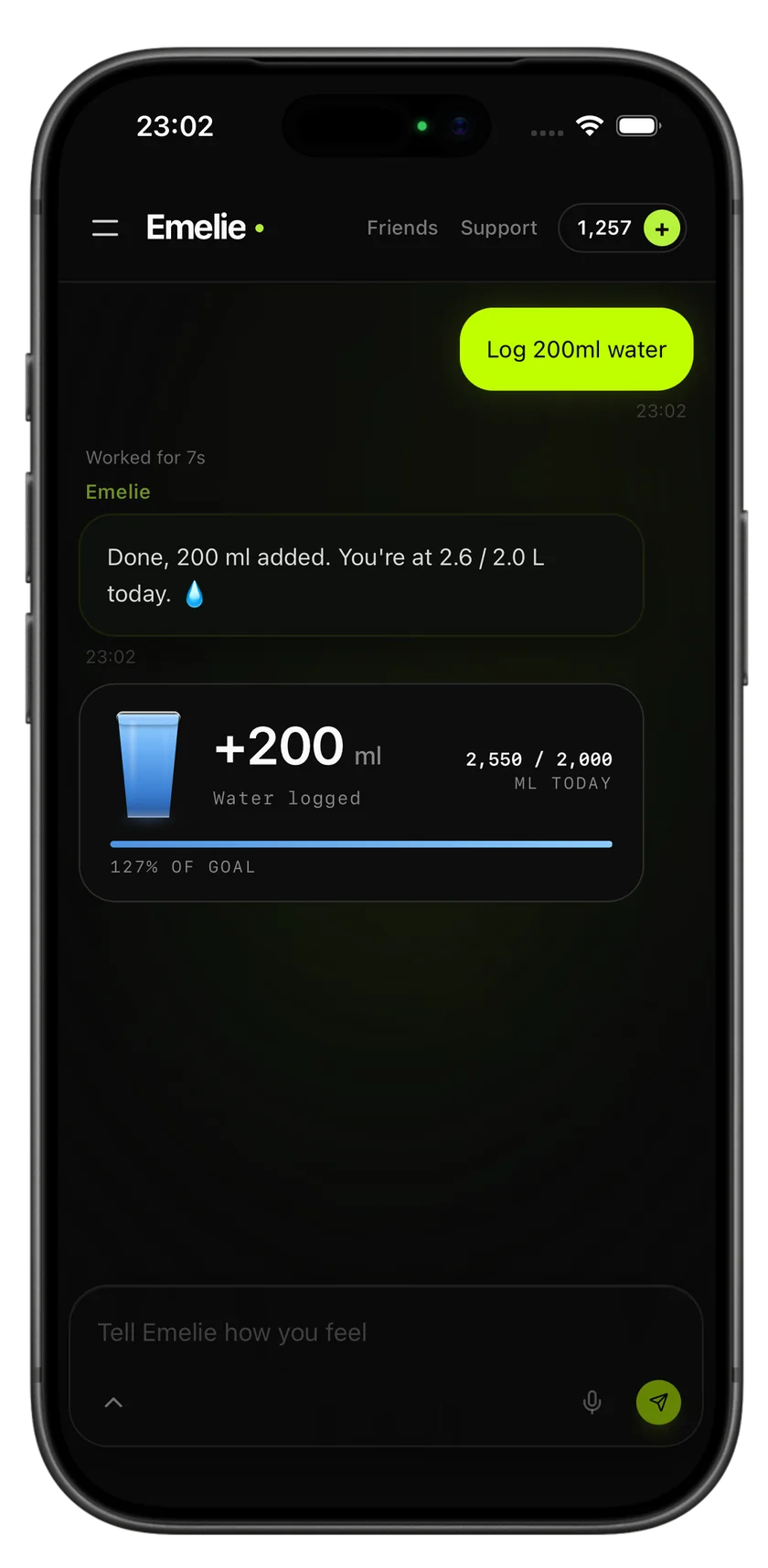
The details got attention too. Logging several of something records the right amount, and correcting a quantity no longer doubles the calories. Water totals are stated exactly. Every tap on the water tracker counts straight away, even several in a row, and you can take a glass back if you tapped once too often. If you have recorded a reaction to a food, Emelie leaves it out of her suggestions and tells you why.
Community Voting: help decide what we build next
This is the feature we are most excited about, because it is not really a feature. HAVYT is still early. The people actually using it every day, many of them living with conditions we can only partly imagine, know better than we do what would help next. So in 1.1 you can tell us, and your vote counts.
Under Profile you will find Help shape HAVYT: a list of what we are considering, from an Apple Watch app and Home Screen widgets to Android, more wearables and more guided sessions. Upvote the ones you want most. The most-voted ideas rise to the top, shipped ones sink to the bottom, and if something you need is missing, send us the idea. The same list is public on the HAVYT roadmap, so you can see what everyone else is asking for too.
Votes are not a promise. Some things are harder than they look, and some of the best ideas are ones nobody has suggested yet. But they will shape the order in which we work, and we will show you what happened to your vote in the release notes.
HAVYT should feel faster
A health app you open ten times a day has to feel instant, and 1.0 did not always. We spent a proper stretch of this release on responsiveness, and you should notice it without reading about it.
- Tabs light up the moment you tap them, instead of a beat later.
- Coming back to Home or the Check-in does far less loading, because HAVYT keeps what it already fetched.
- The first seconds after launch do less in the background, so the screen you asked for arrives sooner.
- Exercise search opens instantly and keeps up with your typing.
- Logging a set is saved on your device first, so a weak gym connection cannot slow you down, duplicate sets or lose a workout.
Dozens of smaller improvements
1.1 also carries a long list of fixes and refinements. A few that people asked for by name:
- Training. Quick Start works again, Quick Workout keeps exactly the reps, weight and RPE you entered, AI recovery sessions open properly with coaching cues and demo videos, and “train light” genuinely reduces today’s session.
- Tracking. Apple Health syncs reliably, reconnects after a reinstall, and no longer shows a sync error when a single measurement is unavailable.
- Notifications. Messages, story replies and friend requests reach you right away; lock-screen notifications no longer show health details; no reminder for a check-in you already did.
- Achievements. Badges and levels are earned from the day you join, and level-up moments wait until you are on a normal screen instead of interrupting a workout.
- What’s New. Release notes show real screenshots and artwork, picked to suit your screen, in the app and on the website.
- Stability. Your music keeps playing when you open HAVYT, verification codes fill themselves in, account deletion finishes properly, and a logged 0 kg shows as 0.
The full list is in What’s New, inside the app and on the website.
I built HAVYT because I wanted to understand why some days with AS felt manageable and others did not. 1.1 is the first version where the app gives that back to me in plain language.
What's next
A short personal note. HAVYT was built after years of trying to understand why some days with ankylosing spondylitis felt manageable while others were much harder. The purpose was never to collect data for its own sake. It was to help make sense of the relationship between symptoms, sleep, movement, training, food, recovery, habits and ordinary daily life. 1.1 is the release where that purpose starts to show up in the app itself: a check-in you keep doing, an assistant that reads what you have tracked, and summaries that put a week into a card.
Next, we keep going in that direction. Emelie will get better at spotting patterns across longer stretches of your history and at explaining them in plain language. The Doctor Report will draw on the same context. And the roadmap is now partly yours: the votes coming in over the next weeks will decide a good part of what 1.2 contains.
As always, if something feels confusing, unnecessary or missing, tell us. Every part of this release started as a message from someone using HAVYT.
Try HAVYT 1.1
HAVYT 1.1 is available now on the App Store. If you already use HAVYT, update the app, open it and do today’s check-in. Then ask Emelie how your week went. If you are new, download HAVYT and start tracking the things that affect how you feel. It is free to start, and the longer you use it, the more it can show you.
HAVYT 1.1 brings your check-ins, training, recovery and habits together, and an Emelie that understands them.